
Introduction
Carbon Fiber Reinforcement has become one of the most effective solutions for extending the life of aging concrete structures. Across the United States, thousands of bridges, parking garages, industrial facilities, and commercial buildings face deterioration due to age, moisture intrusion, corrosion, and increased load demands. According to the 2025 Infrastructure Report Card from the American Society of Civil Engineers, over 42% of U.S. bridges are at least 50 years old, creating an urgent need for cost-effective rehabilitation methods.
Modern engineers increasingly rely on Carbon Fiber Reinforcement because it delivers high tensile strength without adding significant weight. Traditional strengthening methods often require steel plates, larger foundations, and extensive construction work. Carbon fiber systems avoid many of these challenges while improving structural performance.
We have seen Carbon Fiber Reinforcement successfully restore load capacity in aging structures while reducing project downtime. The material is approximately five times stronger than steel by weight and highly resistant to corrosion. These advantages make it an ideal choice for strengthening beams, columns, slabs, and walls.
As infrastructure continues to age, owners need practical solutions that improve safety and extend service life. Carbon fiber technology provides a proven answer backed by decades of engineering research and field applications.
Why Aging Concrete Structures Need Strengthening
Common Causes of Structural Deterioration
Aging concrete structures face continuous stress from environmental exposure and daily use. Temperature fluctuations, water penetration, chemical attack, and reinforcement corrosion gradually weaken concrete elements. Over time, these factors reduce structural capacity and increase maintenance costs.
Many structures were originally designed for lower traffic volumes and lighter loads. Today’s buildings and bridges often experience demands far beyond their initial design criteria. Engineers frequently discover insufficient load capacity during inspections and renovation projects.
Key reasons for strengthening include:
- Corrosion of embedded steel reinforcement.
- Increased live load requirements.
- Seismic upgrade requirements.
- Structural design deficiencies.
- Concrete cracking and spalling.
- Building repurposing projects.
Industry data shows corrosion-related deterioration accounts for nearly 40% of concrete repair costs globally. Early intervention helps prevent larger structural failures and significantly reduces long-term repair expenses.
How Carbon Fiber Reinforcement Works
Strength Through Advanced Composite Materials
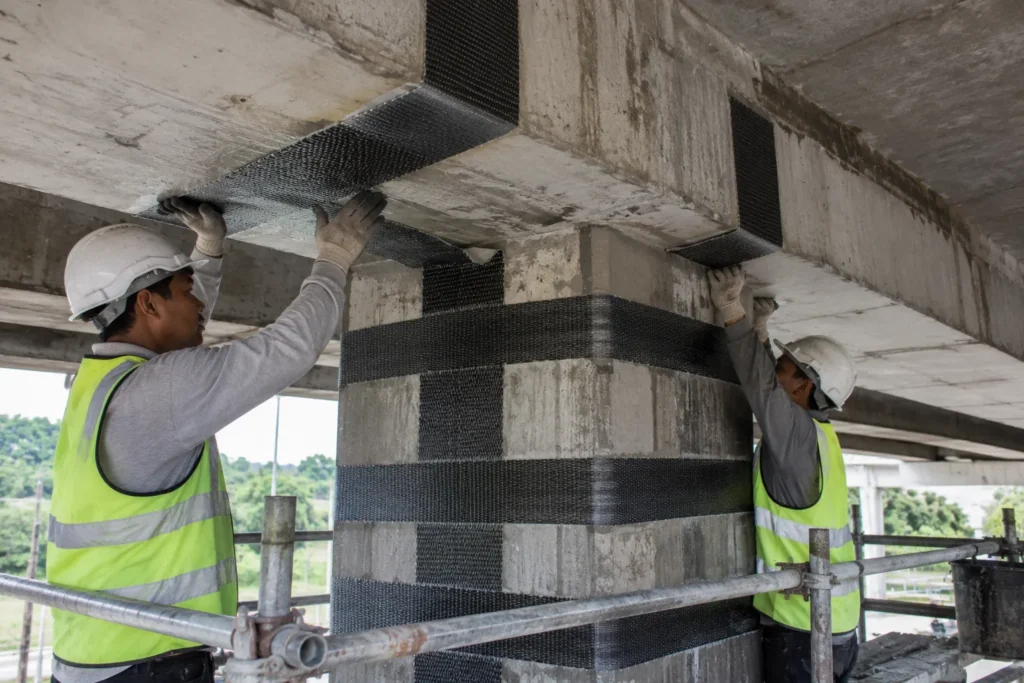
Carbon Fiber Reinforcement uses high-strength carbon fibers embedded within a polymer matrix. These materials are typically installed as sheets, strips, laminates, or wraps bonded directly to concrete surfaces using specialized epoxy adhesives.
The system works by transferring tensile forces from weakened concrete into the carbon fiber material. Once bonded, the fibers help resist bending, shear, and axial loads. This process significantly improves structural performance without increasing dead load.
In practical applications, engineers install carbon fiber laminates on bridge girders, building beams, and floor slabs. Carbon fiber wraps are commonly used around columns to enhance confinement and improve seismic resistance. Explore our solutions for Diver Safety and Risk Management in Underwater Construction
The table below compares carbon fiber with traditional strengthening materials.
| Property | Carbon Fiber Reinforcement | Structural Steel |
|---|---|---|
| Tensile Strength | 3,500 MPa | 550 MPa |
| Density | 1.8 g/cm³ | 7.85 g/cm³ |
| Corrosion Resistance | Excellent | Moderate |
| Installation Time | Fast | Moderate |
| Added Structural Weight | Minimal | High |
| Maintenance Needs | Low | Moderate |
These characteristics explain why engineers increasingly specify Carbon Fiber Reinforcement for rehabilitation projects.
Key Benefits of Carbon Fiber Reinforcement
Improved Performance Without Major Construction
Carbon Fiber Reinforcement offers advantages that traditional strengthening systems often cannot match. The lightweight material minimizes disruption while delivering exceptional structural improvements.
One major benefit is installation speed. Many projects can be completed without shutting down entire facilities. This advantage reduces operational interruptions and associated economic losses.
Important benefits include:
- Up to 70% faster installation than steel retrofits.
- Exceptional fatigue resistance.
- High resistance to moisture and chemicals.
- Minimal increase in structural dimensions.
- Long service life exceeding 50 years.
- Reduced labor and equipment requirements.
From our experience reviewing infrastructure rehabilitation projects, carbon fiber systems consistently provide better strength-to-weight performance than conventional alternatives. Engineers also appreciate the flexibility of the material when working around existing structural elements.
Because the material does not corrode, maintenance requirements remain significantly lower throughout the structure’s lifecycle. This factor often contributes to lower total ownership costs.
Applications in Modern Infrastructure Repair
Where Carbon Fiber Reinforcement Delivers Results
Carbon Fiber Reinforcement is widely used across transportation, commercial, industrial, and public infrastructure sectors. Its versatility allows engineers to address multiple structural challenges using a single technology platform.
Bridge rehabilitation remains one of the largest application areas. Carbon fiber laminates strengthen girders and decks without requiring major reconstruction. Parking structures benefit from slab strengthening and crack control systems.
Common applications include:
- Highway and railway bridges.
- Parking garages.
- Industrial plants.
- Water treatment facilities.
- Commercial buildings.
- Seismic retrofit projects.
- Marine structures.
A 2024 engineering study published by transportation researchers found carbon fiber retrofits increased flexural capacity by more than 45% in several reinforced concrete bridge specimens. Such improvements allow aging infrastructure to safely support modern loading requirements.
As sustainability becomes increasingly important, owners also value the reduced material consumption associated with carbon fiber strengthening methods.
Conclusion
Carbon Fiber Reinforcement has transformed the way engineers strengthen aging concrete structures. Its combination of high strength, low weight, corrosion resistance, and rapid installation makes it one of the most effective rehabilitation solutions available today. Aging infrastructure faces increasing demands, making structural upgrades essential for safety and long-term performance.
We continue to see Carbon Fiber Reinforcement deliver measurable improvements in bridges, buildings, parking structures, and industrial facilities. The technology allows owners to extend service life without costly replacement projects. With proven durability, lower maintenance requirements, and excellent structural performance, carbon fiber systems remain a practical and reliable choice for preserving critical concrete infrastructure for future generations.